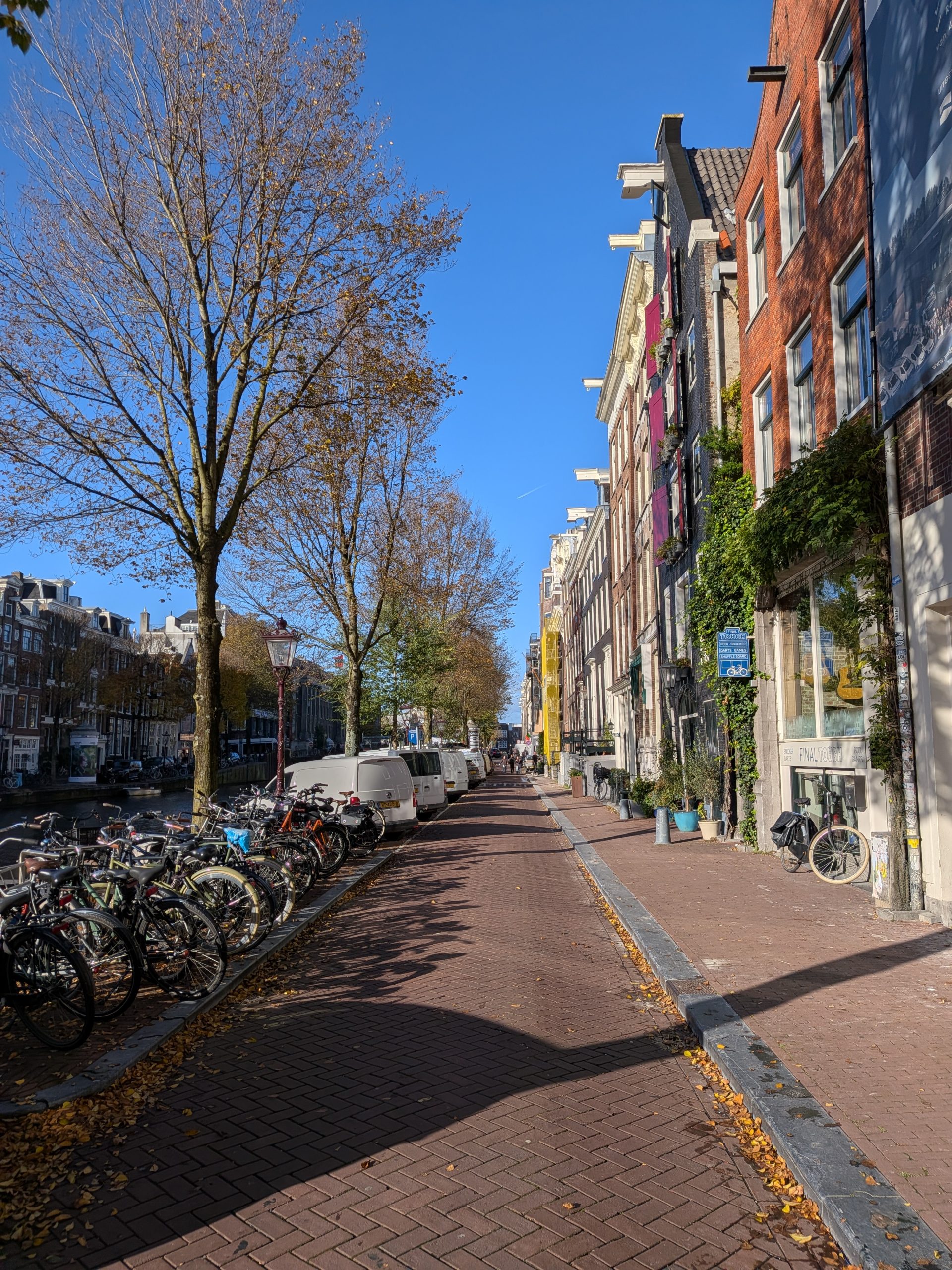
An ordinary family vacation, a deadly encounter, and a return to the same street 52 years later.
In 1974, when I was thirteen years old, my family decided it was time for a little European enlightenment.
My uncle was a history professor at Georgia State University. He had moved his family to Geneva, Switzerland, for a year while conducting research on the Reformation. My parents figured this was a wonderful opportunity to scrub up the kids, take us across the Atlantic, and expose us to a little history and culture.
So off we went. We rented a Volkswagen bus and spent a couple of weeks traveling through Switzerland, Austria, Germany, Belgium, and the Netherlands. It was quite an adventure for a thirteen-year-old American kid.
And then we arrived in Amsterdam.
An Ordinary Afternoon
On April 29, 1974, we had been out for a meal and were returning to our hotel when my father turned our VW bus onto a narrow, one-way street along Amsterdam’s Prinsengracht.
Ahead of us, two police officers were escorting two suspects toward a police car—a Volkswagen Beetle—that was blocking our way. We understood at the time that the men had attempted to rob a Hertz rental car office and had been caught by the police.
As the officers escorted the suspects toward their car, one of the men suddenly broke free and ran to the edge of the canal. I remember watching him appear to remove something from his shoe and toss it into the water before the police quickly caught him and resumed their walk toward the car. At the time, none of us knew what, if anything, he had thrown away.
With nowhere else to go, Dad slowly followed the little procession until we stopped just a few feet behind the police Beetle. I was sitting in the front seat of our VW bus, watching everything unfold.
One officer placed his prisoner in the police car. He then stood partly inside and partly outside the vehicle, occupied with his car radio. The second officer remained outside, searching the other suspect.
That’s when a man approached carrying a briefcase. We assumed he was a Hertz employee. He explained something to the officer using the radio and set the briefcase beside him.
The officer, still occupied with his radio conversation, picked up the case and placed it behind the front passenger seat. I remember that distinctly. I saw only one briefcase, and I did not see anyone examine its contents before it went into the police car.
What none of us realized was that the briefcase contained weapons.
Everything Happened So Fast
The suspect standing outside the police car began resisting the officer who was searching him. Almost immediately, the man inside the Beetle emerged with a pistol and shot the officer in the back.
The officer fell to the ground. I was perhaps ten feet away.
Almost simultaneously, the second suspect obtained a weapon and began firing at the other officer. The wounded officer fell backward over the police Beetle as the gunshots continued.
Our family was sitting in the Volkswagen bus immediately behind the police car. Those old VW buses weren’t exactly spacious, particularly up front. There was nowhere to hide, nothing substantial to duck behind, and hardly any time to react.
The two gunmen ran past our door and down the street. Despite his injuries, the second officer was still conscious. Lying on the ground, he drew his pistol and fired after the fleeing men. He missed them, but one of his bullets struck the front of our Volkswagen bus.
The gunmen escaped. The first officer, Simon Landman, just twenty-one years old, had been fatally wounded. The second officer, Joop van den Berg, had been shot multiple times and was gravely injured.
Somehow, the rest of us had survived.
A Very Long Night
The gunmen were apprehended later that night. Our family spent much of the night at the police station, where my parents were questioned and asked to identify the suspects.
My brother and I were separated from our parents for much of that time. I remember a policewoman who occasionally came in to check on us. I believe her name may have been Levy. She was kind to us, and I remember her making arrangements for our eventual return to the hotel.
I also remember seeing the two suspects being moved through the station in their underwear, handled roughly by the police. At times we could hear them screaming in the hallways. After everything we’d witnessed that afternoon, those sounds frightened us terribly.
We were just kids, thousands of miles from home, in a foreign police station after witnessing something neither of us could possibly have imagined.
Eventually, my brother and I were escorted back to our hotel in another police Volkswagen, this time with two fully armed policemen accompanying us. There were rumors that the suspects had Mafia connections, and the police were concerned about possible reprisals. Guards remained with us overnight as a precaution.
I didn’t sleep much.
The Following Day
The next day, April 30, the police brought us back to the Prinsengracht to participate in a reconstruction of the shooting. Our family returned with the Volkswagen bus. The police Beetle was there, and the suspects were brought back to the scene as well.
My father guided the investigators through the sequence of events, showing them where everyone had been positioned and exactly what had happened. I particularly remember him demonstrating the moment when the suspect outside the police car began resisting the officer who was searching him. That was the moment everything had erupted.
We had told the police about the suspect’s brief escape toward the canal. During the reconstruction, police divers searched the water for whatever he might have thrown in, but as far as we were told, nothing was recovered.
A police photographer documented the reconstruction. Across the canal, enormous crowds had gathered to watch. We later heard that a man carrying a gun had been apprehended on the opposite side of the canal during the proceedings. I never learned whether that report was accurate or whether it had anything to do with our experience.
For a thirteen-year-old boy, returning to the scene of a shooting less than twenty-four hours after witnessing it was a strange experience. The police were trying to piece together the sequence of events. We already knew what it had looked and sounded like because we’d been sitting right in the middle of it.
What I Learned Fifty-Two Years Later
For most of my life, I knew very little about what happened after we left Amsterdam. I knew one officer had died and another had been terribly wounded. I knew the gunmen had been captured and eventually sent to prison, but I never knew much more than that.
In November 2026, while revisiting Amsterdam with my wife, I began looking into the incident again. What I discovered was both fascinating and deeply moving.
The officer who died was Simon A. Landman, a twenty-one-year-old Amsterdam policeman who had been on the force for only about a year. The surviving officer was Joop M. van den Berg, a twenty-two-year-old member of the Royal Netherlands Marechaussee.
The two suspects were Christian Brahmi, a French fugitive, and Gennaro Coppolillo, an Italian accomplice. Contemporary newspaper reports revealed that the police had been waiting for the suspects at the Hertz rental office because of their connection to a wanted fugitive and a rented vehicle. So the story we’d been told about an attempted robbery at Hertz wasn’t quite what had happened.
The newspaper accounts also confirmed that investigators conducted a reconstruction of the shooting on April 30, the day our family returned to the scene. Several articles discussed the suspects’ briefcases, the weapons inside them, and how one of the men had managed to obtain a pistol despite having been searched.
Some details differed from what I remembered. The reports described more than one briefcase and gave somewhat different accounts of precisely where the cases had been placed. I can only describe what I saw from the front seat of our Volkswagen bus.
What I remember most clearly is the officer placing a briefcase behind the front passenger seat while occupied with his radio, the other suspect beginning to resist his search, and the terrible violence that followed.
Then I found something I had never expected.
An interview published in 2022 told the story from the perspective of the officer who survived. Joop van den Berg had undergone extensive surgery for his injuries. One bullet remained lodged in his back because removing it could have caused paralysis. He recovered, went on to live his life, and eventually retired.
For more than fifty years, I had wondered what became of the young officer I watched fall wounded beside that Volkswagen Beetle. Now I finally knew.
There was another unexpected discovery. A newspaper article published immediately after the shooting described a young policewoman named Levy who had helped identify one of the fugitives before the arrest. She was frightened of possible reprisals and deeply affected by what had happened.
I cannot be certain she was the same woman who checked on my brother and me at the police station that night. But I remember a woman I believe was named Levy, and I remember her kindness. After all these years, it was remarkable to find even a possible connection to someone else from that night.
Fifty-Two Years Later
During our November 2026 visit, my wife and I decided to find the street where it had all happened. She had heard me tell the story over the years, probably more than once.
A little internet research pinpointed the location and revealed that a memorial plaque had been placed in the pavement to honor Officer Landman. So we made the approximately mile-and-a-half walk through Amsterdam to find it.
And there it was.
A simple plaque set into the pavement, surrounded by bricks, honoring a young policeman who had given his life in the line of duty on April 29, 1974.
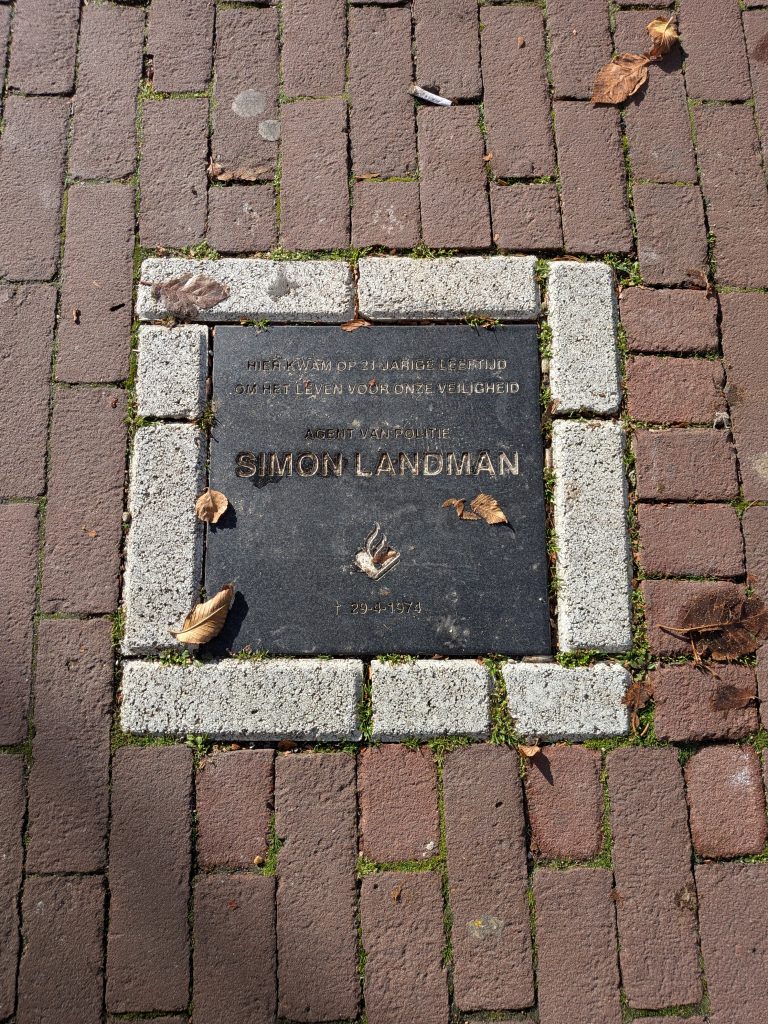
Simon Landman. Twenty-one years old.
I photographed the plaque, then photographed the street. It was an ordinary Amsterdam street, much as I remembered it. Bicycles, buildings, people going about their lives. The world had moved on.
More than half a century had passed since that afternoon when our family’s Volkswagen bus stopped behind a police Beetle and my life came frighteningly close to ending.
Standing there, I could still picture the police car, the briefcase, the gunshots, and the two men running past our door. I remembered the long night at the police station, the frightened screams in the hallways, and the armed officers who escorted us back to our hotel.
I thought about how much had happened in my own life since that afternoon. The places I’d traveled, the people I’d known, the things I’d built, the adventures I’d had, and all the experiences I’d been fortunate enough to enjoy.
And I thought about Simon Landman, a young policeman who never had those years.
I was thirteen when I watched him die. He was only twenty-one.
The years had changed me, but somehow, that place hadn’t changed at all.
I stood there for a while, remembering.
And feeling very, very glad to be alive.
Historical Note
This account is based on my personal recollections of the events of April 29–30, 1974, and my return to Amsterdam in November 2026.
Historical details were supplemented by contemporary Dutch newspaper reports published on May 1, 1974, including coverage in Het Parool, De Telegraaf, and De Tijd, accessed through the Delpher newspaper archive.
Additional information about the officers and the aftermath comes from a 2022 interview with surviving officer Joop van den Berg published in Marechaussee Contact.
Where historical reporting differs from my recollections, I have tried to distinguish what I personally witnessed from what I learned many years later.
The photographs of the memorial plaque and Prinsengracht were taken during my return visit in November 2026.